

The word itself is older than most of the languages that now try to contain it.
Yoni: source, origin, womb, abode, the place from which life issues and to which it returns. In the oldest layers of Indian thought it is not a private part. It is the cosmic matrix - the living doorway through which the world continually regenerates itself.
Long before the word was written in Sanskrit, the form was already being cut into stone and bone.
In the Paleolithic caves of southern France, abstract and realistic engravings of the vulva appear beside the great animals. Some are twenty-five thousand years old. The same shape turns up on small carved stones and on the exaggerated bodies of the so-called Venus figurines that stretch from Europe into Siberia. These were not decorative. They were statements of origin. The body that opens is the body that creates.
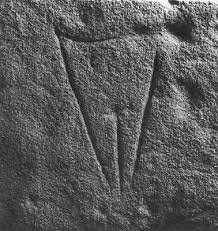
In the subcontinent the evidence is equally deep. At Baghor in Madhya Pradesh, a terminal Upper Paleolithic site dated between nine and eight thousand years before the common era, excavators found a carefully prepared platform of coloured stones arranged around a natural triangular piece of rock. Many scholars read it as an early shrine to the generative feminine. Later, in the Indus Valley cities, female figurines with pronounced breasts and genitals appear in almost every household context. Polished stones with central holes have been interpreted - cautiously, contentiously - as possible early yoni or linga-yoni forms. Whether or not the interpretation is exact, the pattern is clear: the female generative organ was already being treated as sacred long before the Vedic hymns were composed.
When the later traditions crystallised, they did not invent the yoni. They recognised it.
In the Shaiva and Shakta worlds the lingam rises from the yoni the way a mountain rises from the earth. The two together are not two organs in congress; they are the unbroken process of creation itself - consciousness resting in energy, the unmanifest taking form. Temples across the subcontinent still hold this image at their centre. The yoni is the spouted base that receives the offerings; it is the vessel that holds the axis of the world.
Nowhere is the reverence more direct than at Kamakhya on the Nilachala hill in Assam. There is no anthropomorphic image in the sanctum. There is only a natural cleft in the living rock, kept perpetually moist by an underground spring. The tradition says this is the place where the yoni of Sati fell when her body was dismembered. Once a year, during the Ambubachi Mela, the temple closes. The goddess is said to menstruate. Red cloth and water become prasada. Devotees wait outside for the days of her seclusion to end, then return to receive what she has given. The rock itself is the body. The fluid is not pollution. It is the sign that the source is still alive.
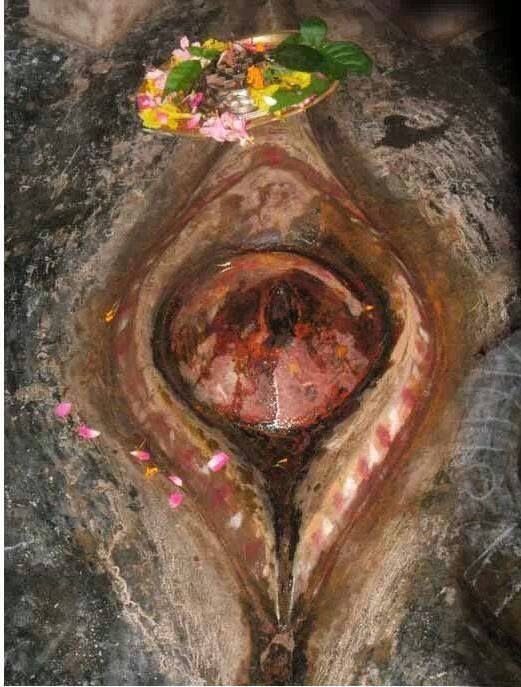
This is not metaphor layered on top of an embarrassing fact. It is the older understanding: the same force that bleeds is the force that births, that regenerates, that refuses to be finished.
Beyond India the same recognition appears in different tongues and different stones. In Mesopotamia the rhombus and the pubic triangle mark the domain of Inanna and Ishtar. In Egypt certain hieroglyphs for “woman” and “vulva” share the same visual root. In Greece the figure of Baubo lifts her skirts and shows the vulva to Demeter, breaking the goddess’s grief with laughter and restoring the cycle of the earth. In medieval Ireland and Britain the Sheela-na-gigs - women carved in stone with legs spread and yoni displayed - were set into the walls of churches and castles. Scholars still argue about their exact meaning, but the posture is unmistakable: the exposed source as protection, as power, as warning and blessing at once.
Across these cultures the yoni is never merely sexual and never merely reproductive. It is the place where the invisible becomes visible, where the world is continually made and unmade. To worship it is to acknowledge that the creative force is not abstract. It has a body. It has a mouth. It has seasons of blood and seasons of stillness.
In the Tantric lineages that grew from these roots, the living woman could herself become the yoni-pitha. The ritual was not always about arousal. It was about recognition. Offerings of flowers, water, light, and attention were made to the actual body of a woman understood as the present form of the goddess. In the more secret Kaula practices the fluids themselves - menstrual blood, sexual exudate - were treated as sacred substances, the kula-dravya, the material of the lineage. Nothing was wasted. Nothing was dirty. Everything that issued from the source belonged to the source.
Modern culture has largely forgotten this. The same organ that once stood at the centre of temples and cave shrines is now more often treated as a site of anxiety, medicalisation, or performance. The ancient view does not ask us to return to the past. It simply reminds us that the body was never only private property or public spectacle. It was - and remains - a doorway.
When the yoni is approached with that older knowledge, something quiet shifts. The organ stops being a problem to be managed or a prize to be won. It becomes what it has always been in the long memory of the species: the place where life keeps insisting on itself.
That insistence is older than any single religion. It is written in stone, in bone, in the annual bleeding of a rock in Assam, and in the bodies of women who still carry the same source inside them.
The worship was never only about the past.
It was always about recognising the origin that is still present.

Conversation
Comments