

History has always been better at preserving the women who had titles.
Cleopatra had a throne. Draupadi had a name in the oldest epic the subcontinent produced. They were recorded, however distorted the record, because the structures of power had to account for them. A queen cannot be ignored by the men who want to control what she rules.
But there is another kind of woman in the historical record - present everywhere, named almost nowhere. She is the one the village sent for when the child's fever would not break. The one men consulted privately about matters they would deny consulting her about publicly. The one whose knowledge was inherited, not licensed, passed between women in the oral tradition that empires were never able to fully burn. She held power that no institution granted her and no institution could entirely revoke - because it lived in the community's need, and the community's need did not disappear when a law was passed against her.
She was called different things in different centuries and on different continents. In Tudor England she was the cunning woman. In the forests of southern Chile she was the Machi. In the colonial Caribbean she was the obeah woman. The names changed. The pattern did not.
What the pattern reveals is this: wherever a structure of power sought to exclude women from formal authority, women built informal authority in the spaces the structure could not reach. And that informal authority was frequently more durable, more intimate, and more threatening to the order of things than any throne.
England, sixteenth century.
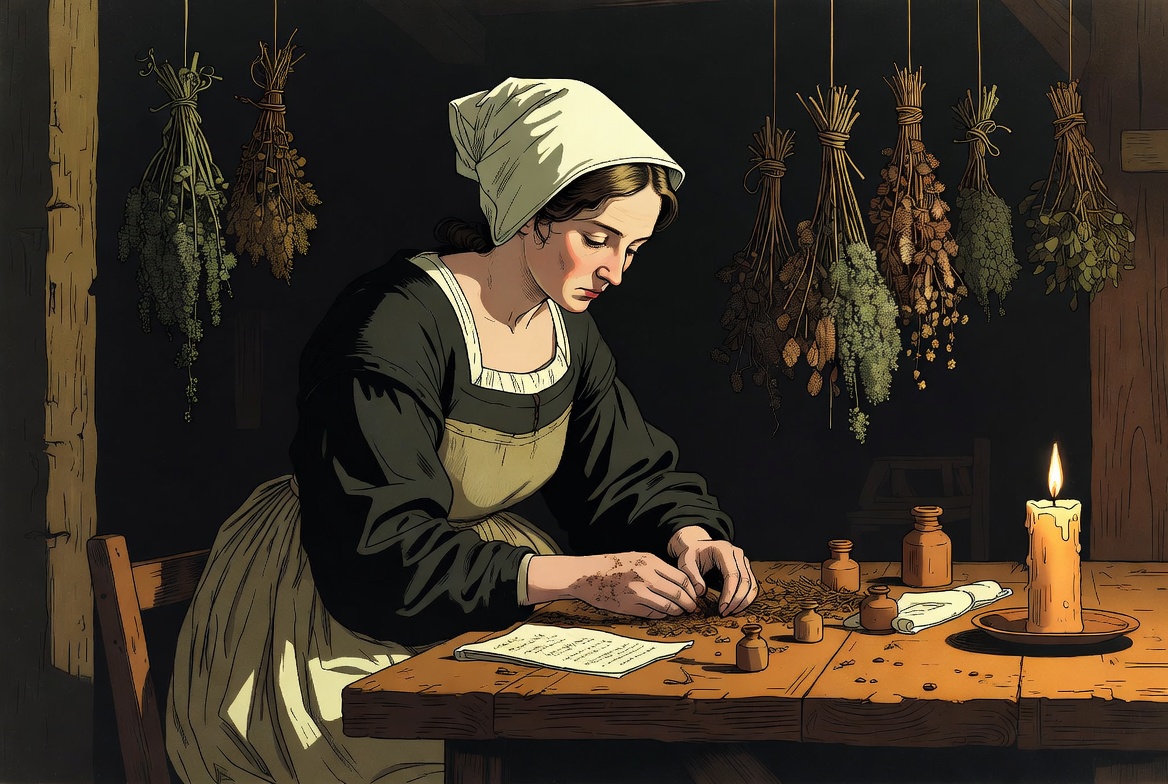
In Tudor England, if your child was sick, your cattle were dying, or something valuable had been stolen, you did not go first to the Church. You went to the cunning woman.
She was known by many names - wise woman, charmer, blesser, in some regions simply the person you went to when nothing else worked. She healed with herbal remedies and spoken charms, found lost objects through ritual, advised on matters of love and dispute, and midwifed half the children born in her parish. Her knowledge was practical, accumulated over decades, and passed down through women who learned it from women before them. She charged for her services. She was, in the most ordinary sense, a professional.
The Church knew it and was furious about it. In 1552, Bishop Latimer complained that when people were in trouble or sick, they ran to wise women rather than clergy. The complaint is the evidence: she was not a fringe figure. She was the first resort.
The Witchcraft Act of 1563 changed the legal ground beneath her, but it did not change the community's need for her. Court records from the period document a striking pattern: communities frequently defended their local cunning women, testified on their behalf, and returned to consulting them even after trials. In Thatcham, Berkshire, in 1583, it was the churchwardens themselves - officials of the very institution that condemned her - who sent for the local cunning woman to find the thief who had stolen the communion cloth from their church. They needed her more than they feared her.
What the witch trials represented, in their most structural reading, was not the persecution of marginal women but the systematic attempt to drive women out of a territory - healing, spiritual counsel, community authority - that men with licenses and institutions were moving to claim. Some historians have proposed that the witch hunts represented a concerted effort to drive women out of health care, and certainly this period shows a significant shift toward licensures and educated male practitioners. The cunning woman was not prosecuted because she was powerless. She was prosecuted because she was not.
Learned male inquiry could be celebrated. Female folk practice could be criminalised. John Dee - mathematician, astrologer, royal adviser, practitioner of ceremonial magic - consulted angels through a medium in his candlelit study and was celebrated as a Renaissance genius. The old woman in the next village who whispered charms over sick children was hanged. The knowledge was not the variable. The gender and the institution were.
Southern Chile, before and after the conquest.
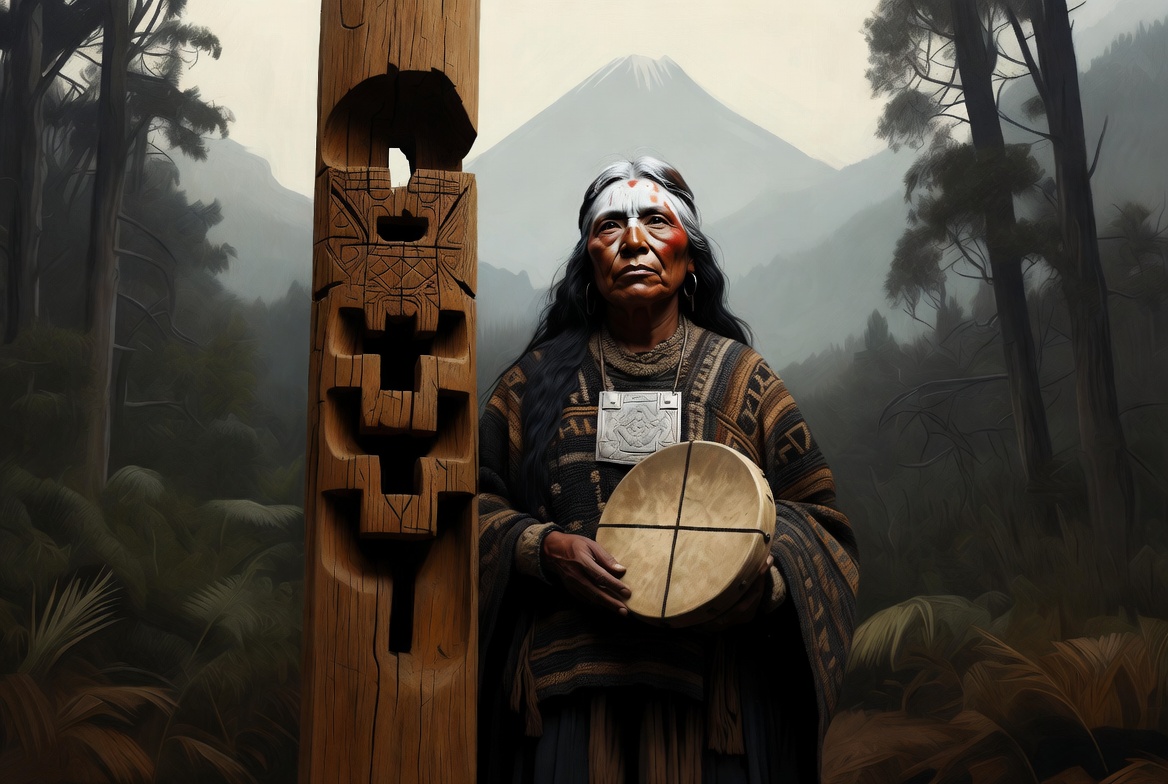
Before the Spanish arrived in the sixteenth century, the Mapuche people of southern Chile had a figure at the centre of their society who was, revered and honoured as the only leader their society consulted on issues of health or discord amongst their tribe. She was called the Machi. She was traditionally a woman.
Mapuche belief places spiritual authority overwhelmingly in the hands of women - a striking inversion of the warrior society around it. The Mapuche were among the most formidable military resisters of Spanish colonisation in the Americas, holding off conquest for over a century. Their warriors were men. Their spiritual and healing authority belonged primarily to women.
The Machi's power was specific and total. She was the intermediary between the human world and the spirit world - climbing the carved rewe, a ladder-pole cut from a sacred tree, in trance states during healing ceremonies, negotiating with ancestral spirits on behalf of the sick and the community. Many Mapuche people still turn to the Machi as their fundamental religious leader, particularly in rural communities, where the healing ritual known as machitun is still practiced. Her drum, the kultrung, is designed by each Machi according to the specific spiritual knowledge given to her — it is not a generic object. It is the physical record of her particular power.
What the Spanish encountered in the Machi was a form of authority they had no framework for. A woman who was not a queen, not a wife of a chief, not defined by her relationship to male power - but who held the spiritual and medical life of a warrior society in her hands. They called her a witch. They subjected her practices to the same colonial logic that the Church applied to the cunning women of England: spiritual authority exercised by a woman outside Christian institutional structure was, by definition, diabolical.
Machi have been females or feminised men since the sixteenth century, three hundred years before the creation of the Chilean state. The Chilean state that eventually subsumed Mapuche territory also stigmatised the Machi, labelling her a witch and a sexual deviant. The pattern - informal feminine authority, official persecution, community survival — repeats across continents and centuries with remarkable consistency.
The Machi survived anyway. Unlike the fossilised state religions of the Aztec and Inca, Mapuche belief survives as practice - the Machi still climbs the rewe today. The institution could not be destroyed because it was not an institution. It lived in the relationship between a woman and her community's need. That relationship proved harder to colonise than a city.
The Caribbean, seventeenth to nineteenth centuries.
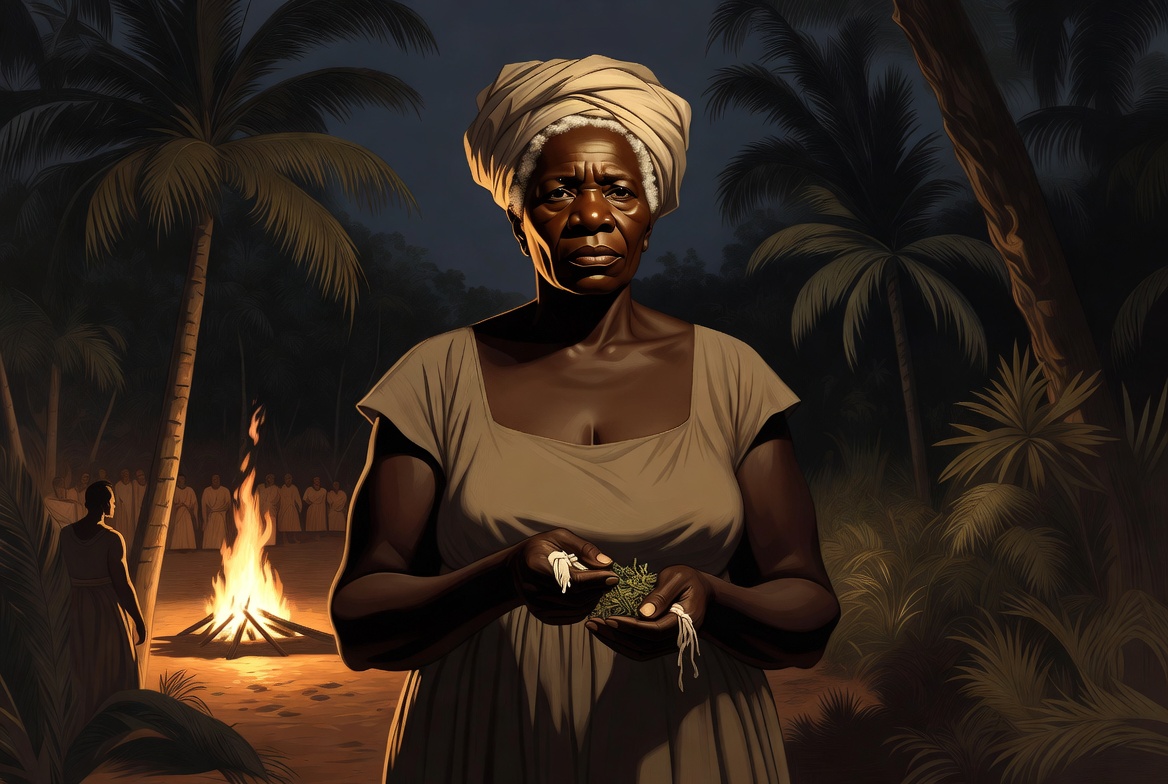
The obeah women of the colonial Caribbean practiced something the British Empire feared enough to criminalise by law.
Obeah is rooted in West African religious practices, notably among the Akan, Yoruba, and Igbo peoples, who were brought to the Caribbean during the transatlantic slave trade. They brought with them their own beliefs, the use of herbal remedies, and the ability to invoke deities or communicate with ancestors. As enslaved Africans arrived in the islands, they carried this knowledge with them - encoded in memory and practice because it could not be carried in any other form, because everything else had been taken. For enslaved Africans, obeah was also a form of resistance against colonial oppression.
The obeah woman held authority in two registers simultaneously. In the first, she was a healer - working with plant knowledge, spiritual practice, and the accumulated pharmacological understanding of her West African inheritance adapted to Caribbean flora. This set of knowledge practices was likely influenced by Indigenous Caribbeans, who had a deep knowledge of the medicinal nature of the flora and fauna of the Caribbean. In the second register, she was something the colonial system found far more dangerous than a healer: a source of power that did not depend on the coloniser's permission and that the colonised community trusted more than they trusted colonial medicine or colonial law.
Whether obeah man or obeah woman, the practitioners of obeah were central to the health, both medical and social, of the communities they were entrenched within. The obeah woman was consulted on matters of illness, justice, protection, and survival. She was paid for her services. She had standing. The promise of helping others in their communities helped to alleviate the threats enslaved women faced - not only were some obeah women paid for their consultations, they gained a social power that would have otherwise been unavailable to them in the Caribbean.
The British criminalised obeah for the same reason they criminalised everything else that gave enslaved people autonomy: it was working. Between the prohibition of the British slave trade in 1807 and slavery's end in 1833, colonial agents increasingly turned their attention toward enslaved women and the particular ways these women might have utilised obeah practices to resist the theft of both their productive and reproductive labour. The obeah woman was not a peripheral spiritual figure the colonisers could ignore. She was directly implicated in organised resistance - present in Tacky's Revolt in Jamaica in 1760, one of the largest slave uprisings in the Caribbean. Obeah was demonised in British writing as paganism, devil worship, and sorcery - not because the British believed it was supernatural but because they understood, at the level of administration, that it was organising.
The law against obeah remained on the books in some Caribbean nations until the twenty-first century. Jamaica repealed the Obeah Act only in 2013. The lag is its own evidence: informal feminine spiritual authority, two centuries after emancipation, was still considered threatening enough to remain criminalised.
The pattern.
Three cultures. Three centuries. Three names for the same figure.
In each case: a woman whose authority was not granted by any institution, derived instead from knowledge accumulated and passed between women, exercised in direct relation to community need. In each case: official structures of power - the Church, the colonial state, the conquering empire - moved to suppress her, called her a witch, a deviant, a danger. In each case: the community continued to need her, continued to come to her, and the knowledge survived.
What the cunning woman, the Machi, and the obeah woman share is not a spiritual tradition. They share a structural position. They existed in the space between what institutions controlled and what communities required. That space was, in each case, enormous. Healing, spiritual counsel, justice, protection, the management of birth and death and crisis - these needs did not disappear because a law was passed or a Church preached against them. The woman who could answer those needs held power that was, in practical terms, more intimate and more durable than the power of many who held titles.
Queens can be deposed. Thrones can be seized. The woman the whole village has been consulting for thirty years, who knows every family's secrets, who delivered their children and prepared their dead, who holds the pharmacological knowledge of three generations of women before her - she is harder to replace and harder to erase. The structure feared her because it could not easily replicate what she did. She was not supplementary to community life. She was load-bearing.
And yet history, written by the institutions that prosecuted her, mostly did not preserve her name.
The feral inheritance.
The Tygra archetype - the feral matriarch, the woman who holds sovereign power in the spaces no institution has reached - is not a mythology invented in the present. She is a pattern retrieved from the historical record.
She was in Tudor England, unnamed in the parish register but named in the community's need. She was in the forests of southern Chile, climbing the rewe before the Spanish knew the continent existed. She was in Jamaica and Barbados and Trinidad, carrying West African knowledge across the Middle Passage in the only vessel the slavers could not confiscate: the body, the memory, the voice.
Empires could not name her accurately because to name her accurately would have been to acknowledge what she was: a woman who held power that did not derive from them and did not require their permission.
They called her a witch instead.
She kept working.
Feral Voice publishes essays for women who only answer to themselves. The Roots pillar recovers the women history forgot to preserve.
Conversation
Comments